Enter "entrepreneurial traits" into Google, and the menu of frequent searches will complete the query with "... of Steve Jobs" and "... of Bill Gates," among others. These are the forces of nature that spring to mind for most of us when we think of entrepreneurs--iconic figures who seemed to burst from the womb with enterprise in their DNA.
What does it take to be a successful entrepreneur? Is it being born a prodigy? Is it having a Type-A personality? Is it being an extrovert who spends all their time tinkering around on projects?
While some entrepreneurs have those traits, they rarely define the characteristics that make a majority of entrepreneurs. Not everyone is born with an intellect that will change the world. That student who couldn’t make it through college, like Bill Gates, is more likely to succeed than the lifelong overachiever.
So, if you’re not a born genius or overachiever, what personalities actually make-up entrepreneurs? Here are our five common personality traits that entrepreneurs possess.
If Hollywood wants to portray an entrepreneur in a movie, then he -- and it’s usually a he – is in his early 20s, may or may not have a college degree, is probably wearing blue jeans and a hoodie, and is a bit unkempt, with messy hair and facial hair.
That stereotype may appeal to our interest in a narrative where geeks take over the world, but the Mark Zuckerberg-inspired vision is absolutely only a part of the entrepreneurship story. Many entrepreneurs don’t even think about launching their own business until they are in their 30s, 40s, and even 50s, after years of work experience.
The label of “serial entrepreneur” is a point of pride in the start-up world, an indication that this is not your first rodeo. In a survey asking about factors that contributed to their success, entrepreneurs ranked past successes and past failures above everything but prior work experience. Yet new research from from the Centre for European Economic Research casts doubt on that belief.
It comes as no surprise that entrepreneurs are an optimistic bunch. Research has confirmed as much, suggesting that entrepreneurs suffer from an “optimism bias,” one that is linked to both advantages and disadvantages. Optimism can help entrepreneurs persist in the face of a challenge, but it can also lead them to take imprudent risks.
Having a great, defensible business idea in a scalable market is only part of the puzzle to attracting venture capital. A more important part is having a backable management team that can pull off the execution of the plan. Below are the top 4 traits VC’s desire in their startup founders:
The Founder Institute has a vision to launch over 1,000 meaningful and enduring technology companies per year by identifying strong candidates with limited or no entrepreneurial experience, and turning them into strong startup founders through a four-month training program.
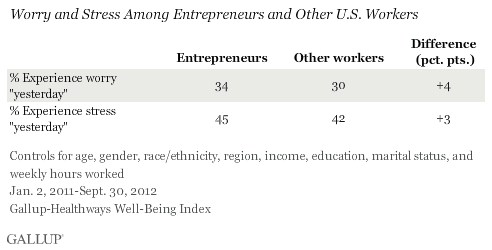
More stress appears to be a modest drawback of being an entrepreneur in America. In the U.S., entrepreneurs are slightly more likely than other workers to report experiencing stress a lot of the day "yesterday"-- 45% vs. 42%. They are also slightly more likely than other U.S. workers to say they worried a lot of the day "yesterday"-- 34% vs. 30%.
“WE need some gray hair” once referred to needing someone with more experience. But I haven’t heard that expression in a very long time.
In fact, many companies are intentionally reducing the average age of their work forces in an effort to save money. Younger employees are generally paid less and have lower health care expenses and retirement costs. As one executive remarked to me recently, “I don’t think anyone really likes this — we all know our own 50-year-old moment will be coming, too.”