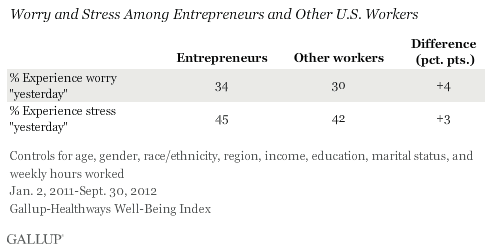
More stress appears to be a modest drawback of being an entrepreneur in America. In the U.S., entrepreneurs are slightly more likely than other workers to report experiencing stress a lot of the day "yesterday"-- 45% vs. 42%. They are also slightly more likely than other U.S. workers to say they worried a lot of the day "yesterday"-- 34% vs. 30%.
Soon after the class of 2009 collected their degrees, they stepped into the worst job market in a generation. Hiring for new college graduates had dropped 35 to 40 percent in only a year. Hiring for new PhDs, lawyers, architects, and journalists had plummeted as well. Even new graduates who managed to secure work often accepted jobs that did not require a college or graduate degree, and they typically earned substantially less than they would have if they had left school two years earlier.
The many struggles of entrepreneurship have been well covered in news stories and personal blogs: the late nights, the financial uncertainty, the pressure to attract customers or clients. Starting a venture is inherently risky and therefore inherently stressful.
And yet, starting up and running your own business also comes with some very tangible rewards. A study by the University of Pennsylvania's Wharton School of Business found a strong correlation between entrepreneurship and happiness, one that held even if the start-up in question wasn't phenomenally successful.
The many struggles of entrepreneurship have been well covered in news stories and personal blogs: the late nights, the financial uncertainty, the pressure to attract customers or clients. Starting a venture is inherently risky and therefore inherently stressful.
And yet, starting up and running your own business also comes with some very tangible rewards. A study by the University of Pennsylvania's Wharton School of Business found a strong correlation between entrepreneurship and happiness, one that held even if the start-up in question wasn't phenomenally successful.
We can thank entrepreneurs for much of the success of the global economy over the past half century. And if we're going to emerge from the worldwide economic slump, entrepreneurs will lead the way.
Most leaders and policymakers don't have a clue about what makes entrepreneurs successful.
These driven, creative individuals know plenty about battling adversity. They've overcome infrastructure and regulatory hurdles to start their businesses. Often, they've fulfilled an unsatisfied demand and, in many cases, actually built demand by introducing new products to the market.