Portrait de Mikel Orobengoa

Organización: 

ISEA

Chinese Researchers Stop Wheat Disease with Gene Editing.

Advanced genome-editing techniques have been used to create a strain of wheat resistant to a destructive fungal pathogen—called powdery mildew—that is a major bane to the world’s top food source, according to scientists at one of China’s leading centers for agricultural research.

To stop the mildew, researchers at the Chinese Academy of Sciences deleted genes that encode proteins that repress defenses against the mildew. The work promises to someday make wheat more resistant to the disease, which is typically controlled through the heavy use of fungicides. It also represents an important achievement in using genome editing tools to engineer food crops without inserting foreign genes—a flashpoint for opposition to genetically modified crops.

Mobile Health’s Growing Pains.

Among technologists, mobile health is thriving. Since the start of 2013, more than $750 million in venture capital has been invested in companies that do everything from turn your smartphone into a blood pressure gauge to snapping medical–quality images of the inner ear. Apple, Qualcomm, Microsoft, and other corporate giants are creating mobile health products and investing in startups. 

The idea is straightforward: the increasing number of smartphones means that small, inexpensive sensors, low-energy Bluetooth, and analytic software make it possible for patients and doctors to capture all kinds of data to improve care. Patients can play a more active role in their own health. Doctors and nurses can make house calls without ever leaving the office. 

Zillow buys Trulia for $3.5B to create an online real estate giant.

Two of the biggest online real estate companies are joining forces.

Zillow announced today that it’s buying rival Trulia for $3.5 billion in stock. The two companies will maintain their separate brands, but Trulia CEO Pete Flint will report to Zillow CEO Spencer Rascoff. The deal is expected to close in 2015.

Why I love the Care Space Stace.

Startups are attacking just about every vertical.  However, I’ve been surprised to see one industry where there hasn’t been much startup activity.  Perhaps because it’s unsexy and support calls may be life or death situations.  It is an $84B industry in the US. The Elder Care IndustryAn $84B industry represents an estimated 3M+ individual workers in the industry.  People may be hesitant to enter this market because of difficulties working with Medicare and Medicaid.  I can only imagine how difficult it is to work with them.  But there is plenty of reason for optimism.

An Indoor Positioning System Based On Echolocation.

GPS doesn’t work indoors. Can a bat-like echolocation system take its place?


The satellite-based global positioning system has revolutionised the way humans interact with our planet. But a serious weakness is that GPS doesn’t work indoors. Consequently, researchers and engineers have been studying various ways to work out position in doors in a way that is simple and inexpensive.

Hello’s Sense sleep tracker is wary of the wearable.

You may love your wearable, but you shouldn’t take it to bed.

That’s the argument made by James Proud, the founder of Hello who recently created a runaway success on Kickstarter with the launch of the Sense sleep coach.

Proud knows something about decisions that one may lose sleep over. A few years back, the 22 year-old gave up a chance to be the first in his family to attend college in order to accept an opportunity offered to be mentored by venture capitalist Peter Thiel. But he has now attracted veterans from Apple and Fitbit to attack a better understanding of our everyday sleep with a product called Sense.

Modernizing the Medical Record.

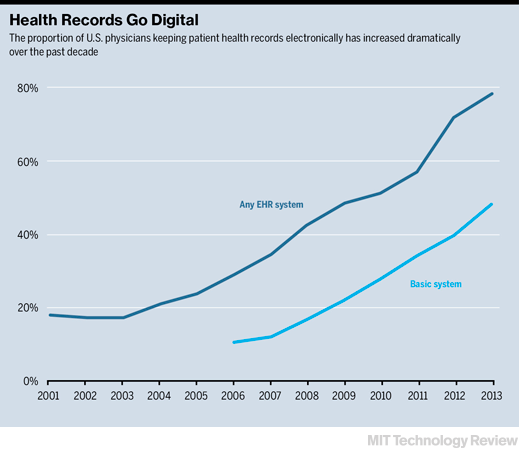
As medical data goes digital, patients gain power.

In April, a San Francisco–area startup called BaseHealth announced health-management software that integrates diet, exercise, genetic tests, and medical records, then calculates a patient’s risk for more than 40 diseases—including type 2 diabetes, lung cancer, and Alzheimer’s disease—and suggests ways to lower the risk of developing them. 

Solar Survivors: Bay Area Startups Innovate Under the Radar

The solar industry has had a brutal shakeout, making it very difficult for any solar energy startup to introduce next-generation cell technology. But, despite the fierce global price competition—and the flight of many venture investors from solar—there are a few signs that interest in novel solar technology is picking up.

La iniciativa E3! cuenta ya con 10 proyectos propuestos por las empresas.

Las empresas continúan formalizando su interés para participar en Etorkizuna Elkarrekin Eraikiz!, una iniciativa del BAC de MONDRAGON, que cuenta con el apoyo de EPS – MU. Como consecuencia, el listado de proyectos alcanza ya las 10 propuestas.

Las empresas pueden participar en  el proceso E3! proponiendo proyectos concretos, orientados a la generación de oportunidades de negocio a corto plazo, susceptibles de ser materializadas mediante proyectos de emprendimiento desarrollados por equipos multidisciplinares compuestos por  jóvenes titulados universitarios.

Las empresas que se adhieran al proceso E3! se beneficiarán de esta iniciativa al…:

Groups Mikel contributes to

Suivi

This person isn't following anyone.